


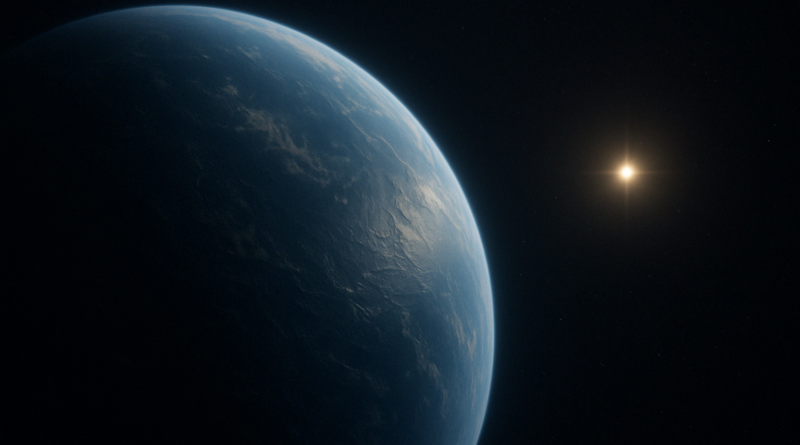
NASA’s Webb Telescope Detects Potential Life Signatures on Distant Exoplanet K2-18b
In a groundbreaking discovery, scientists using NASA’s James Webb Space Telescope (JWST) have identified chemical signatures possibly linked to alien life on K2-18b, an exoplanet nine times the size of Earth and located in the habitable zone of its star system.
Published in The Astrophysical Journal Letters, the study reports the potential detection of dimethyl sulfide (DMS) and dimethyl disulfide (DMDS)—two biosignature gases rarely found beyond Earth but commonly associated with marine plants and bacteria on our planet.
🌍 K2-18b: A Promising “Hycean” World
Astronomers classify K2-18b as a Hycean planet, meaning it likely features a hydrogen-rich atmosphere and a global ocean of liquid water—two essential ingredients for life as we know it.
-
The planet is about 9 times Earth’s mass
-
It orbits a red dwarf star in the Goldilocks Zone (where conditions may be suitable for life)
-
JWST’s Mid-Infrared Instrument (MIRI) detected key molecules as the planet transited its star
🧪 DMS: A Possible Signature of Life
On Earth, DMS is almost exclusively produced by biological organisms, especially ocean-dwelling phytoplankton. The detection of such a compound in K2-18b’s atmosphere hints at potential biosignatures, although the study’s authors stress that further observations are essential to verify the finding.
-
Earth’s DMS levels exceed 10 parts per million by volume (ppmv)
-
On K2-18b, scientists estimate similar or higher concentrations, possibly indicating non-biological sources yet to be understood
🚀 Key Findings So Far:
-
Methane and carbon dioxide were detected on K2-18b in 2023
-
These are the first carbon-based molecules confirmed in an exoplanet habitable zone
-
Possible DMS signals were found, though not yet statistically significant
-
Presence of DMDS complicates interpretations due to overlapping spectroscopic features
“The results underline the potential for habitability on exoplanets and demonstrate the power of JWST to detect signs of life,” said one project scientist.
🔬 What’s Next?
While the findings are compelling, scientists remain cautious. They aim to:
-
Gather higher resolution data from JWST
-
Explore non-biological pathways that could produce DMS and DMDS
-
Confirm the chemical composition of K2-18b’s atmosphere with future missions
Until then, K2-18b stands as one of the most promising candidates in the ongoing search for extraterrestrial life.