


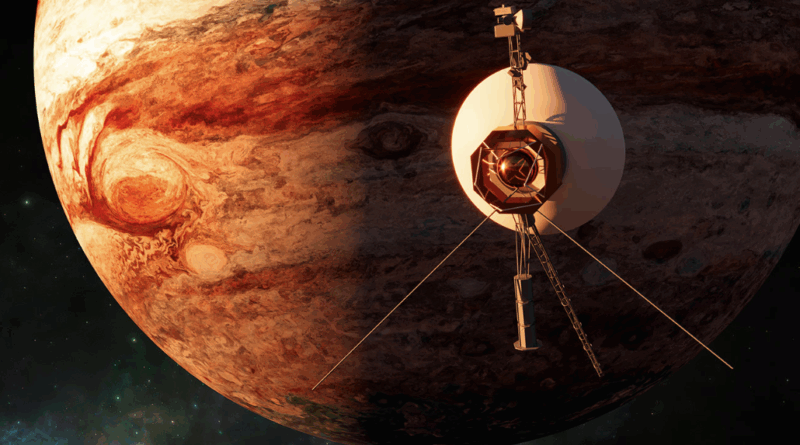
NASA’s 1970s Voyager Computer Is Still Working — 25 Billion Kilometers Away
In an age where consumers rush to upgrade their devices annually, NASA’s oldest operational computer is not only still functioning — it’s thriving over 25 billion kilometers from Earth on board the Voyager spacecraft.
🛰️ Voyager’s Ancient Tech Still Beaming Back Science
Launched in 1977, Voyager 1 and Voyager 2 carry a total of six onboard computers, each no faster than a calculator today but still running crucial missions. Built shortly after the invention of the floppy disk in the early 1970s, these 18-bit and 16-bit computers, designed by General Electric for NASA’s Jet Propulsion Laboratory, control everything from navigation to data transmission. Each probe carries two of each model as backups — a redundancy plan that’s helped them endure for nearly five decades.
“The master clock runs at 4 MHz but the CPU’s clock runs at only 250 KHz,” NASA explains. “That’s about 8,000 instructions per second, compared to 14 billion in a 2013 smartphone.”
Despite the performance gap, these machines reliably send scientific data from interstellar space, with their 8-track tape recorder holding just 68 kilobytes — less than a modern JPEG.
🧠 Ancient Memory, Modern Ingenuity
To maximize efficiency, Voyager overwrites old data once it’s sent back to Earth, allowing NASA to keep gathering new information. These techniques enabled the legendary Jupiter and Saturn flyby images — captured and sent with data rates as low as 19.2 kbps.
“Full-frame, full-resolution TV from Saturn was obtained by slowing the scan to 144 seconds per frame and transmitting at 44.8 kbps,” NASA notes.
🛠️ Software Fixes from Billions of Miles Away
Though hardware upgrades are impossible, the Voyager team managed a software patch when Voyager 1’s flight data system became corrupted in 2022. With no large memory block available, NASA engineers cleverly split the affected code into smaller segments, distributed them across memory, and rewired the codebase to run seamlessly again.
“They divided the code into sections and stored them in different places… ensuring it functioned as a whole,” NASA explained.
This level of innovation showcases not only the resilience of 1970s space engineering, but the enduring ingenuity of the scientists who keep it alive — even from 167 AU (astronomical units) away.