


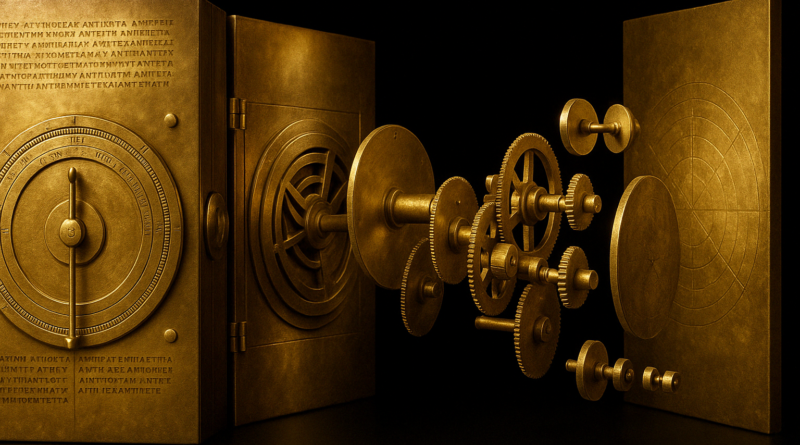
Antikythera Mechanism May Never Have Worked, New Study Says
The Antikythera Mechanism, often hailed as the world’s oldest analog computer, might not have functioned at all according to a recent, yet-to-be peer-reviewed study. Long celebrated as a technological marvel of the ancient world, this 2,000-year-old relic may have been more of an aspirational artifact or educational prototype than a working astronomical device.
A Marvel from the Deep—or a Mechanical Mirage?
Discovered in 1901 at the site of a 2,000-year-old shipwreck off the coast of Antikythera, Greece, the device was thought to be an astronomical calculator capable of tracking the movements of celestial bodies, including the Sun, Moon, and planets. Dated to around 60 BCE, the Antikythera Mechanism consists of a series of interlocking gears and dials —an incredibly complex design for its time.
However, the mechanism’s current corroded and fragmented state has left scientists puzzled for decades. With many parts missing, deformed, or eroded, scholars have long debated whether the device ever truly worked.
Modeling the Malfunction: Two Key Studies Reassessed
The authors of the new study sought to answer this lingering question by combining insights from two previous studies:
-
Alan Thorndike’s analysis focused on the triangular shape of the gear teeth, revealing that it would likely cause non-uniform motion, including acceleration and deceleration during operation.
-
Mike Edmunds’ CT scan-based study exposed manufacturing flaws such as uneven spacing and misaligned teeth on the gears—flaws that would pose serious functional problems.
Using this data, the researchers created a computational model to simulate the mechanism’s mechanical behavior. Their findings were sobering:
“Under our assumptions, the errors identified by Edmunds exceed the tolerable limits required to prevent failures,” they explained.
One particularly glaring example showed that the solar pointer, one of the key components of the system, would likely jam before completing one-third of its cycle, essentially stopping the entire mechanism—since all gears are interdependent.
Was It a Precision Tool or a Pedagogical Prototype?
The researchers propose two possibilities:
-
The Antikythera Mechanism never functioned due to design flaws.
-
The observed errors were not present in the original manufacturing and only appeared after centuries of sea corrosion.
“The mechanism would have required an extraordinary level of precision to operate as intended,” the study’s authors argue. Such accuracy might have been beyond the capabilities of even the most skilled ancient Greek artisans.
This has led many, including Edmunds, to theorize that the device was created as a model or teaching aid, demonstrating the concept of astronomical tracking rather than serving as a reliable tool for observation.
Still, the new study emphasizes caution:
“Much of the data produced by Edmunds is speculative,” the authors note, warning that any conclusions about the mechanism’s function should be interpreted with great care.
A Tool or a Testament to Imagination?
Regardless of whether the Antikythera Mechanism actually worked, its existence reveals a civilization grappling with the cosmos using the tools of mathematics and engineering long before the industrial age.
Even if the device was never fully operational, it remains a symbol of ancient ingenuity, highlighting a moment when art, science, and imagination converged beneath the Mediterranean waves.