


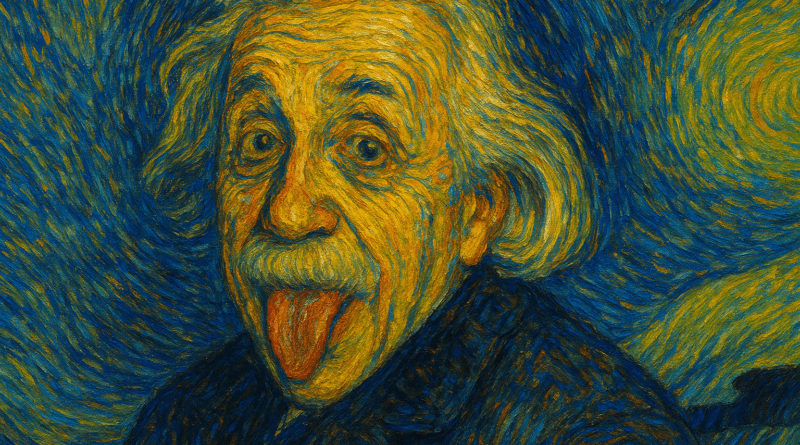
Was Einstein wrong about the double slit experiment? MIT researchers says yes
A groundbreaking experiment by researchers at MIT has taken the iconic double-slit experiment to its most “idealized” form yet—once again challenging Einstein’s interpretation of quantum behavior and reinforcing the eerie yet precise predictions of quantum mechanics.
Revisiting the Quantum Riddle That Redefined Physics
In 1801, physicist Thomas Young conducted the now-famous double-slit experiment, demonstrating that light behaves as a wave. When passed through two slits, light didn’t produce two bands on a screen, as would be expected if it were purely particulate. Instead, it formed an interference pattern, revealing its wave-like nature—an observation that upended Isaac Newton’s corpuscular theory, which had treated light as a stream of massless particles, or “corpuscles”.
But the real strangeness emerged in the decades that followed. When scientists tried to determine which slit the light passed through, the wave interference pattern disappeared—replaced by a result suggesting that light was acting like a particle. The act of measurement itself disrupted the system, illustrating the deeply unintuitive world of quantum mechanics.
Einstein vs. Bohr: A Thought Experiment Becomes Real
While Albert Einstein accepted that light could act as both a wave and a particle—earning a Nobel Prize for his work on the photoelectric effect—he doubted that observation alone could truly alter outcomes. He theorized that with the right apparatus, like a screen attached to springs to detect which slit a photon went through, the interference pattern could remain intact.
Niels Bohr, however, countered with the Heisenberg uncertainty principle: the more precisely one measures a particle’s position, the less precisely its momentum can be known. According to Bohr, attempting to observe which slit a photon passed through would always destroy the interference pattern.
Over the years, increasingly refined experiments—including those using spring-based detectors—have consistently shown that the act of measurement erases the interference pattern, supporting Bohr’s view and undermining Einstein’s.
MIT’s Quantum Lattice: The Ultimate Slit Simulation
Now, researchers at MIT, led by Vitaly Fedoseev and Nobel laureate Wolfgang Ketterle, have conducted what may be the most precise and controlled variation of the double-slit experiment to date. While their goal was initially to study ultracold atoms and the way light scatters off them, the setup unexpectedly provided an ideal platform to test the duality of light.
Using laser beams, the team cooled over 10,000 atoms to microkelvin temperatures, arranging them in a crystal-like optical lattice. At such temperatures, each atom became isolated from its neighbor—acting like the tiniest conceivable “slits”. When a weak beam of light passed between two such atoms, it essentially recreated the double-slit scenario, but at an atomic scale.
“These single atoms are like the smallest slits you could possibly build,” said Ketterle, the John D. MacArthur Professor of Physics at MIT.
By varying how tightly atoms were held—making them “fuzzier” or more fixed—they observed a change in how the light behaved. Loosely confined atoms allowed for more interaction with the light, making it act more like particles, while tightly bound atoms allowed wave-like interference to dominate. Their findings precisely matched quantum mechanical predictions.
“We realized we can quantify the degree to which this scattering process is like a particle or a wave,” said Fedoseev. “And we quickly realized we can apply this new method to realize this famous experiment in a very idealized way.”
A Quantum Victory Over Classical Intuition
The team’s conclusion delivers another decisive blow to Einstein’s hope that a clever enough detector could bypass quantum rules. Even without springs, the interference pattern vanishes if the system allows which-path information to be extracted.
“In many descriptions, the springs play a major role,” Fedoseev noted. “But we show, no, the springs do not matter here; what matters is only the fuzziness of the atoms. One has to use a more profound description, which uses quantum correlations between photons and atoms.”
This study doesn’t just reinforce the uncanny predictions of quantum physics—it also confirms that our classical intuitions are insufficient to grasp how the universe truly behaves.
And after more than a century of debate, the double-slit experiment still refuses to be fully understood—or ignored.