


Are We in the Best Universe for Life? Astronomers Say Maybe Not
We still have no evidence of life beyond Earth, but given that we exist, it’s plausible that life might be scattered across the cosmos. Yet, even more intriguing is the question: does our universe have the best conditions for life? Surprisingly, new research suggests the answer could be no.
This team of astronomers found inspiration in the Drake Equation, which is typically used to estimate the likelihood of intelligent life elsewhere. However, this time, they applied the concept on a grander scale, examining a trait that might influence life across multiple universes—dark energy.
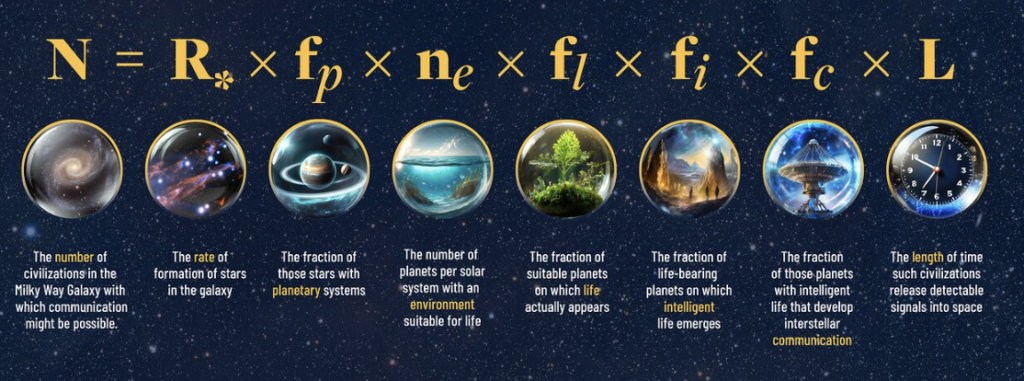
Image: Drake Equation
Dark energy, an unconfirmed but theoretically necessary form of energy, could explain the universe’s accelerated expansion. If it exists, its effects extend to star formation and thus to the potential for life. Here in our universe, around 23 percent of regular matter transforms into stars, which is essential for life as we know it. Yet, their models reveal that in universes with higher dark energy levels, this efficiency could increase to 27 percent, potentially supporting even more life by creating more stars.
“Understanding dark energy and the impact on our Universe is one of the biggest challenges in cosmology and fundamental physics,” commented Dr. Daniele Sorini from Durham University’s Institute for Computational Cosmology.
His team considered a vast range of universes, from those with no dark energy to those with 100,000 times more than ours. They calculated the odds of each universe generating intelligent observers, with star quantity as a key indicator of potential life.
Their results are striking: some universes might indeed produce life more readily than ours. Still, our universe’s dark energy level is notably close to the one that maximizes star formation, making it a rare yet almost optimal cosmos for life.
“It will be exciting to employ the model to explore the emergence of life across different universes,” added Professor Lucas Lombriser from Université de Genève, hinting at future research that could reshape our understanding of why we’re here.