


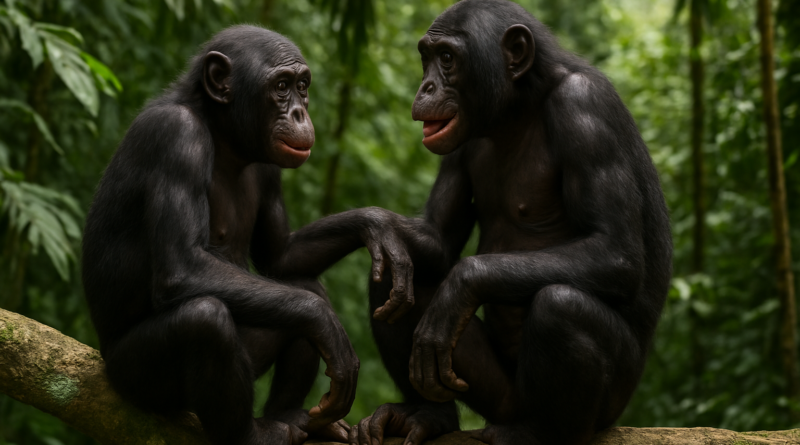
Bonobo Calls Reveal Unexpected Parallels with Human Language, Study Finds
What might sound like wild jungle noise to the human ear—the hoots, peeps, and whistles of bonobos—may in fact represent a sophisticated form of communication with remarkable similarities to human language, according to a new study by researchers at the University of Zürich and Harvard University.
Bonobos: The Most Vocal Great Apes
Among the great apes, bonobos are the most vocally expressive, producing a wide variety of sounds. From high-pitched hoots and whistles that carry through the jungle to intimate grunts and soft peeps, their vocal range is more complex—and higher in pitch—than their close relatives, the chimpanzees.
Although physically similar to chimpanzees, bonobos’ octave-higher vocalizations serve different social and environmental functions, according to the research team.
Bonobo Communication Exhibits Linguistic Compositionality
By analyzing over 700 wild bonobo vocal recordings, the researchers identified more than 300 distinct contextual features linked to specific call types. Crucially, the study found that bonobo vocalizations exhibit “compositionality”, a core feature of human language.
Compositionality refers to the ability to combine individual elements (like words or sounds) into meaningful structures. In linguistics, this comes in two types:
-
Trivial compositionality: Each component keeps its own meaning (e.g., “blonde dancer”).
-
Nontrivial compositionality: One word modifies another in a way that changes the overall meaning (e.g., “bad dancer” doesn’t mean a morally bad person who dances, but someone poor at dancing).
Bonobos Use Nontrivial Compositionality—Just Like Us
What astonished researchers was that three out of the four vocal structures used by bonobos show nontrivial compositionality—a rare and advanced feature even among animal communication systems.
“This is what makes human language so flexible—and now we see the same structural elements in bonobo calls,” said lead researcher Mélissa Berthet, who also captured recordings of subtle vocal sequences during social displays.
For example, a peep followed by a whistle in tense social situations (like a bonobo dragging a branch in front of others) indicates a nuanced emotional and social context, far beyond the simplicity of a single sound.
Clues to the Origins of Human Language
Bonobos, along with chimpanzees, share approximately 98.8% of their DNA with humans, making them our closest living relatives. These findings offer valuable clues about how complex human language may have evolved from the communication systems of ancestral primates.
Understanding the non-human primate language structure not only expands our view of bonobo intelligence but also brings scientists one step closer to decoding the evolutionary roots of human linguistic ability.
SEO Highlights: evolution of human language, bonobo vocalizations and compositionality, bonobo nontrivial communication, University of Zürich bonobo study, primate language research Harvard