


Parker Solar Probe Captures Stunning Solar Wind During Record Breaking Sun Flyby
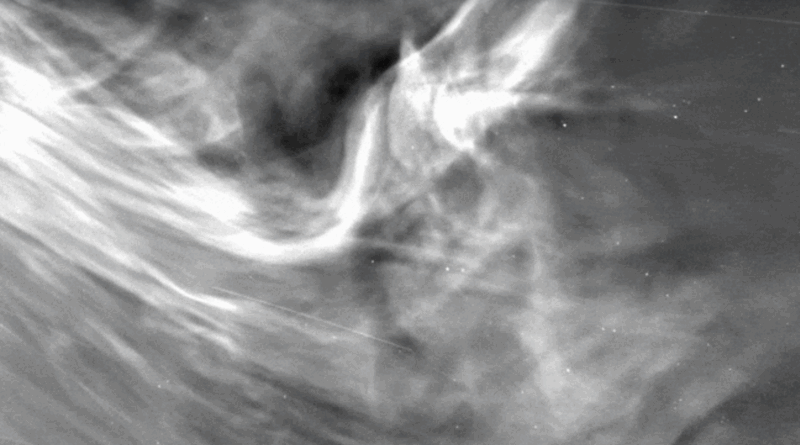
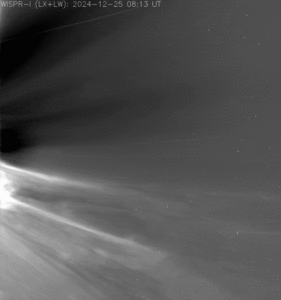
On December 24, 2024, NASA’s Parker Solar Probe delivered a unique holiday gift flying just 6.1 million kilometers (3.8 million miles) from the Sun, the closest approach it will ever make. During this historic pass, the spacecraft captured a rare image of the solar wind, streams of charged particles blasting from the Sun at speeds exceeding 1.6 million kilometers (1 million miles) per hour.
You might wonder why Parker didn’t photograph the Sun’s surface while being so close. The answer: extreme heat. The probe’s heat shield can withstand over 1,000°C in the Sun’s outer atmosphere (the corona), while keeping its instruments at a comfortable 29°C (85°F). However, pointing a camera directly at the Sun would let in enough light to dangerously heat and damage the onboard systems, even with filters.
Instead, Parker’s WISPR (Wide-field Imager for Solar Probe) instrument recorded waves of plasma escaping the corona during the record-breaking flyby on December 25, 2024. This ongoing mission allows scientists to “touch the Sun” at each perihelion, the closest point in its orbit, collecting critical data on particles and magnetic fields that shape space weather.
📸Credit: NASA/Johns Hopkins APL/Naval Research Lab
“Parker Solar Probe has once again transported us into the dynamic atmosphere of our closest star,” said Nicky Fox, Associate Administrator for NASA’s Science Mission Directorate. “We are witnessing where space weather threats to Earth begin, with our eyes, not just models. This new data will vastly improve our predictions to protect astronauts and technology across the Solar System.”
One of Parker’s key goals is solving mysteries about the solar wind, which exists in both fast and slow forms. The slower solar wind, traveling at around 350 km/h (220 mph) is denser and less understood.
“The big unknown has been: how is the solar wind generated, and how does it escape the Sun’s immense gravity?” explained Nour Rawafi, project scientist at Johns Hopkins Applied Physics Laboratory. “Understanding this continuous flow, especially the slow solar wind, is a major challenge. But with Parker, we’re closer than ever to uncovering its origins.”
Since that December encounter, Parker completed two more close passes on March 22 and June 19. Upcoming flybys are set for September 15 and December 12. Its proximity to the Sun also makes Parker the fastest human-made object ever.
The mission will continue until the probe’s thrusters run out of fuel. At that point, the spacecraft will rotate, exposing its instruments to the Sun’s full intensity, destroying them instantly. The heat shield, however, will endure for millions of years, locked in its orbit around our star.