


🦴 Tiny Prehistoric Shark Discovered in Mammoth Cave Redraws Ancient Marine Map
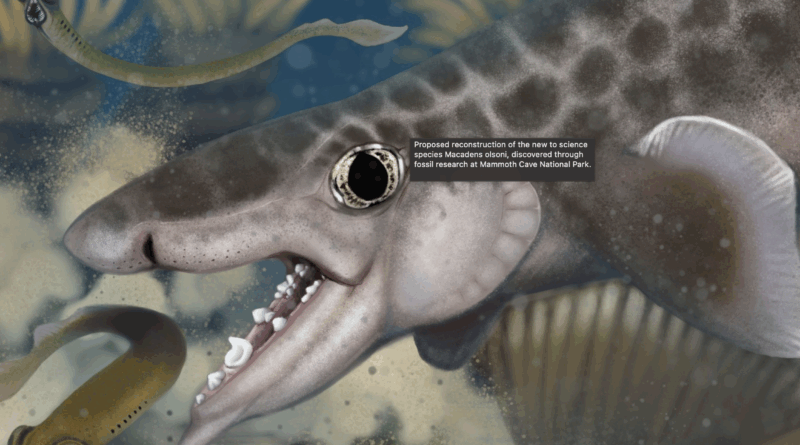
The fossil-rich depths of Mammoth Cave National Park in the U.S. have revealed yet another incredible find: a newly discovered species of ancient shark, dubbed Macadens olsoni. Though small in stature—just under 30 centimeters (12 inches) long—this ancient predator made a big evolutionary splash in the shallow tropical seas that once covered the region more than 335 million years ago.
🌊 From Cave to Seafloor: A Window into Earth’s Marine Past
Discovered within the Ste. Genevieve Formation, a limestone-rich geological layer dating back 340–335 million years, M. olsoni adds to the growing body of fossil evidence showing that the area—now far from the coast—was once a bustling marine habitat. This prehistoric sea connected regions of what are now eastern North America, Europe, and northern Africa, forming a vibrant ecosystem teeming with life.
The tiny shark preyed on mollusks and marine worms, using a distinctive curved tooth whorl—a spiral set of teeth adapted to crushing shelled creatures. This rare dental structure helped M. olsoni stand out among fossilized finds.
“This discovery is a remarkable addition to our understanding of ancient marine life,” said Barclay Trimble, Superintendent of Mammoth Cave National Park. “It underscores the importance of preserving and studying our natural history.”
🔬 Taxonomic Twists: A New Genus Emerges
The research team noted that M. olsoni shares features with a previously known species, Helodus coxanus. However, deeper analysis suggested that H. coxanus may not belong in the Helodus genus after all. Instead, they propose reclassifying it into a new genus called Rotuladens, hinting at a broader reshuffling of ancient shark taxonomy.
“Every discovery connects the past with the present and offers invaluable educational opportunities,” added Trimble.
🦷 A Treasure Trove Beneath the Earth
M. olsoni is one of many fossilized sharks uncovered in Mammoth Cave, the world’s longest cave system, as part of an extensive paleontological project. This initiative not only surveys national parks for fossils but also evaluates their scientific value, ensuring proper management and conservation.
Among the other ancient finds is the McGinnis’ nail tooth shark (Clavusodens mcginnisi), a fellow 340-million-year-old creature whose sharp bite and small size earned its relatives the nickname “chipmunk sharks.”
In a rare stroke of preservation, researchers also unearthed partial remains of a fossilized shark skull—an extraordinary find since shark skeletons are made of cartilage, which rarely fossilizes. Another discovery included a new species of ctenacanth, which pushed the origin of its genus back by an astonishing 50 million years.
These discoveries highlight the critical role of paleontology in educating the public, expanding evolutionary timelines, and revealing how today’s landscapes were once submerged worlds filled with marine predators.