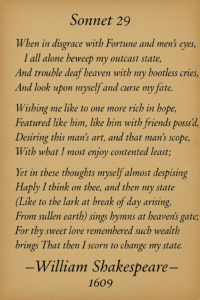



When Fortune Frowns: The Soul Behind Shakespeare’s Sonnet 29
In the quiet shadow of Shakespeare’s celebrated comedies and tragedies lies a collection of 154 sonnets—intimate, philosophical, and often achingly human. Among them, Sonnet 29 stands out as a deeply personal meditation on despair, envy, and ultimately, the redemptive power of love.
Written around 1592–1598 and published in 1609, this sonnet is part of the so-called “Fair Youth” sequence—a mysterious series of poems believed to be addressed to a young man of striking beauty and virtue. While scholars still debate the true identity of the “Fair Youth,” many agree that the sonnet reflects the vulnerability and emotional honesty rarely seen in Shakespeare’s theatrical work.
Sonnet 29 opens with the poet in a state of emotional ruin: rejected by society, forgotten by fate, and wracked by jealousy over others’ fortunes. It is a stark portrait of human insecurity. Yet, in a powerful turn—typical of Shakespeare’s genius—the tone shifts. The mere thought of the beloved lifts the speaker from despair, likening their joy to a lark rising at dawn, singing hymns to heaven.
This sonnet, though brief, reveals volumes about the nature of self-worth, the healing capacity of affection, and the timeless struggle between inner demons and outer perception. In this way, Shakespeare immortalizes a very modern anxiety in a voice that transcends time.
Below, we present Sonnet 29 in its original poetic form, rendered on parchment as it might have appeared in Shakespeare’s own hand—an ode to the enduring ache and solace of the human heart.